



Amazon Xmas deals are one of the most searched and anticipated shopping experiences of the holiday season, shaping how millions of people decide what to buy, how fast to buy it, and where to place their trust in 2025. More than a collection of discounts, Amazon Xmas deals reflect how price, convenience, delivery confidence, and interface design come together under peak seasonal pressure. In this article, we look beyond promotional labels and examine how these deals actually work for shoppers. Using four bestselling products from Amazon’s Xmas deals experience — an induction Bluetooth speaker phone stand, a HERTIENDO graphene food warming mat, a 6FT Christmas inflatable snowman family, and an aromatherapy shower steamers 8-pack — we analyse where Amazon genuinely delivers value, where perception does the heavy lifting, and how UX design influences holiday buying decisions far more than discounts alone.
Amazon Xmas Deals Bestsellers in 2025
Christmas remains the most emotionally and financially charged shopping season of the year. For consumers, it is a period of heightened expectations: better prices, faster delivery, fewer mistakes, and less cognitive effort under time pressure. For platforms, it is a stress test of their entire user experience — from discovery to checkout to post-purchase reassurance. In 2025, this tension is more visible than ever.
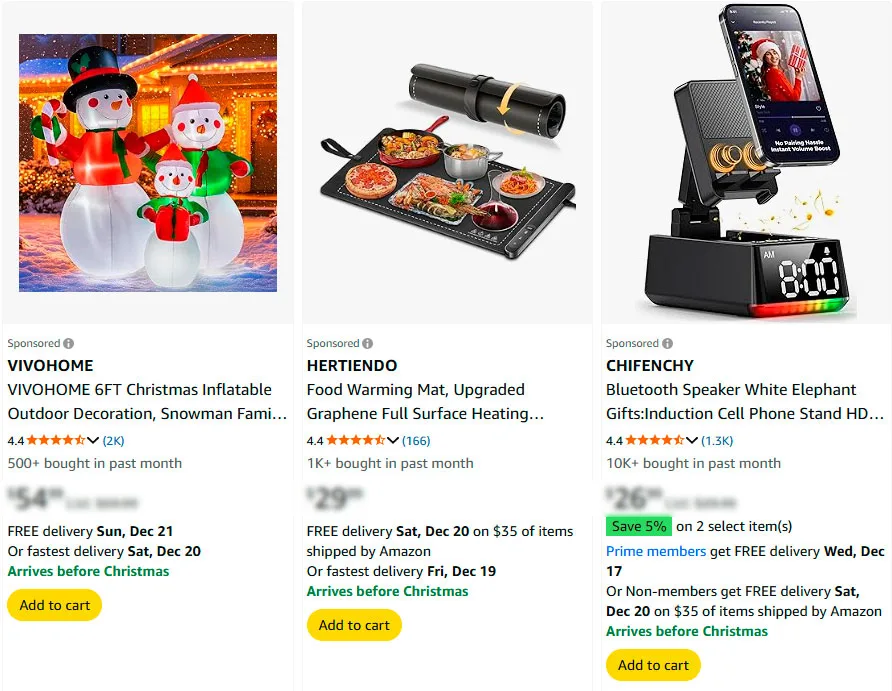
Screenshot of Best Amazon Xmas Deals in 2025
Amazon Xmas deals sit at the centre of this seasonal behaviour. For millions of shoppers across Europe and North America, Amazon is no longer just one option among many — it is the default entry point. People arrive not necessarily because they believe Amazon always has the lowest price, but because they expect certainty: reliable delivery before Christmas, predictable service quality, and an interface they already know how to navigate. In UX terms, Amazon wins the moment before the user even starts comparing alternatives.
That makes Amazon an especially interesting case to analyse. This article is not about promoting discounts or celebrating sales numbers. Instead, we step back and look at the real experience behind amazon xmas deals in 2025. How clearly are offers communicated? How easy is it to understand whether a deal is genuinely good? Where does the interface reduce friction — and where does it quietly introduce pressure, confusion, or dependency on Prime?
Our goal is practical and user-centric. By examining four featured products from Amazon’s Xmas deals landing experience, and by looking closely at how Amazon Prime reshapes the value proposition during the holidays, we aim to answer a simple but important question: are Amazon Xmas deals truly convenient and beneficial for shoppers, or do they merely feel that way?
If you are responsible for designing digital experiences, managing loyalty programs, or optimising customer journeys, you will recognise many of the patterns discussed here. And if you are a shopper yourself, you may start to notice how much of your holiday buying behaviour is guided — sometimes subtly — by UX decisions rather than price alone.
What Shoppers Expect from Amazon Xmas Deals
By the time users search for amazon xmas deals, most of the decision-making has already happened at a psychological level. They are not browsing casually. They are under time pressure, often buying for other people, and carrying a strong fear of getting it wrong — the wrong gift, the wrong size, the wrong delivery date. This context shapes expectations long before price enters the equation.
The first expectation is obvious but often misunderstood: shoppers expect discounts, not necessarily the lowest price on the internet. In UX research, we consistently see that perceived value matters more than absolute savings during peak seasons. A clearly framed “Christmas deal” with visible savings feels safer than a slightly cheaper offer buried elsewhere. Users want reassurance that they are acting wisely, not hunting endlessly for marginal gains.
Closely tied to this is the distinction between price and value. During the holiday period, the feeling of a good deal is constructed from multiple signals: crossed-out prices, limited-time labels, social proof, and delivery guarantees. Amazon leans heavily on these cues. The platform understands that users are buying confidence as much as products. A deal that looks official, time-bound, and well-supported often converts better than a quieter but objectively cheaper alternative.
Fast and predictable delivery is another non-negotiable expectation. In 2025, speed is no longer a bonus feature — it is part of the product itself. Shoppers implicitly calculate risk: will this arrive before Christmas, and will I have time to fix things if it does not? Amazon’s promise of specific delivery dates, especially for Prime members, directly reduces this anxiety. From a UX perspective, delivery clarity functions as emotional insurance, not logistics information.
Simplicity of choice plays an equally important role. Faced with hundreds of potential gifts, users want Amazon to narrow the field for them. Xmas deals pages are expected to act as curators, not catalogues. Shoppers trust the platform to surface “safe” options — popular, well-reviewed, and suitable as gifts — without forcing them into deep comparison mode. When that trust holds, cognitive load drops dramatically.
Taken together, these expectations form an implicit set of UX evaluation criteria. Users judge amazon xmas deals on clarity, reassurance, and effort reduction more than on raw discounts. Any friction — unclear savings, confusing delivery terms, overwhelming choice — immediately undermines perceived value. Understanding these expectations is essential before we can meaningfully assess how well Amazon’s 2025 Xmas deals actually perform.
How Amazon Structures Xmas Deals in 2025
In 2025, shoppers encounter amazon xmas deals long before they intentionally go looking for them. The entry points are deliberately distributed across the ecosystem: the homepage hero banners, personalised deal modules, category-level prompts, and seasonal collections that follow users as they scroll. From a UX standpoint, Amazon treats Xmas deals less as a destination and more as an ambient layer woven into the entire shopping journey.
Once inside the deals environment, users are presented with several distinct offer types, each designed to trigger a slightly different behaviour. Limited-time deals appeal to planning-oriented shoppers who want reassurance without urgency overload. Lightning deals, by contrast, introduce countdown timers and stock indicators that increase arousal and shorten decision cycles. Prime-only offers quietly reinforce membership value, often positioning exclusivity as part of the “smart shopper” identity. None of these mechanisms are new, but in 2025 they are more tightly integrated and visually consistent across surfaces.
The way savings are communicated is central to how these deals are perceived. Amazon typically combines multiple signals: percentage discounts, absolute price reductions, reference prices, and contextual labels such as “Xmas deal” or “limited time.” While this density of information can feel persuasive, it also raises transparency questions. Experienced users often notice that reference prices are not always intuitive, and the true depth of savings requires mental effort to verify. The UX challenge here is balance: making deals feel substantial without forcing users into scepticism.
Navigation and filtering during the holiday period reveal Amazon’s strength and its limits. On the positive side, filters for price range, delivery date, rating, and Prime eligibility directly align with seasonal decision criteria. These controls allow users to quickly eliminate risk rather than optimise for price alone. However, the sheer volume of deals means that filtering often feels like damage control rather than exploration. Users are narrowing chaos, not browsing inspiration.
This leads to the most debated aspect of Amazon’s Xmas deals experience: interface density. The festive period amplifies visual noise — banners, badges, countdowns, and recommendations compete for attention. For some users, this abundance creates momentum and a sense of opportunity. For others, especially less frequent shoppers, it increases cognitive load and decision fatigue. From a UX research perspective, the interface helps selection when users arrive with a clear intent, but it can hinder choice when they are still searching for gift ideas.
Amazon’s 2025 Xmas deals structure reflects a deliberate trade-off. The platform optimises for coverage and urgency rather than calm curation. Whether this helps or hinders the shopper depends less on the deals themselves and more on how well the experience matches the user’s mental state at that moment.
Product Snapshot 1: Induction Bluetooth Speaker Phone Stand by CHIFENCHY
This Xmas deal represents a typical Amazon holiday “safe gift.” The CHIFENCHY induction speaker phone stand promises instant sound amplification without Bluetooth pairing, positioned clearly for gifting rather than tech performance.

Induction Bluetooth Speaker Phone Stand by CHIFENCHY
The discount is modest — 10 percent, from $29.99 to $26.99 — but the perceived value is reinforced through strong trust signals: Amazon’s Choice, a 4.4-star rating, and 10K+ recent purchases. For many shoppers, this social validation outweighs the shallow price reduction.
The product card is information-dense: price, reference price, delivery expectations, free returns, and multiple secondary promotions appear immediately. This creates confidence but also mild cognitive noise, requiring users to filter what actually matters.
From a UX perspective, Amazon succeeds by framing the product as low-risk and universally suitable. The deal feels convenient and reassuring, even if the financial saving itself is relatively small — a recurring pattern across Amazon Xmas deals.
Product Snapshot 2: Graphene Food Warming Mat by HERTIENDO
The HERTIENDO Store targets a more practical holiday need: keeping food warm during gatherings. Its value lies in functionality — full-surface graphene heating, foldable silicone design, and multiple everyday use cases — rather than festive impulse appeal.
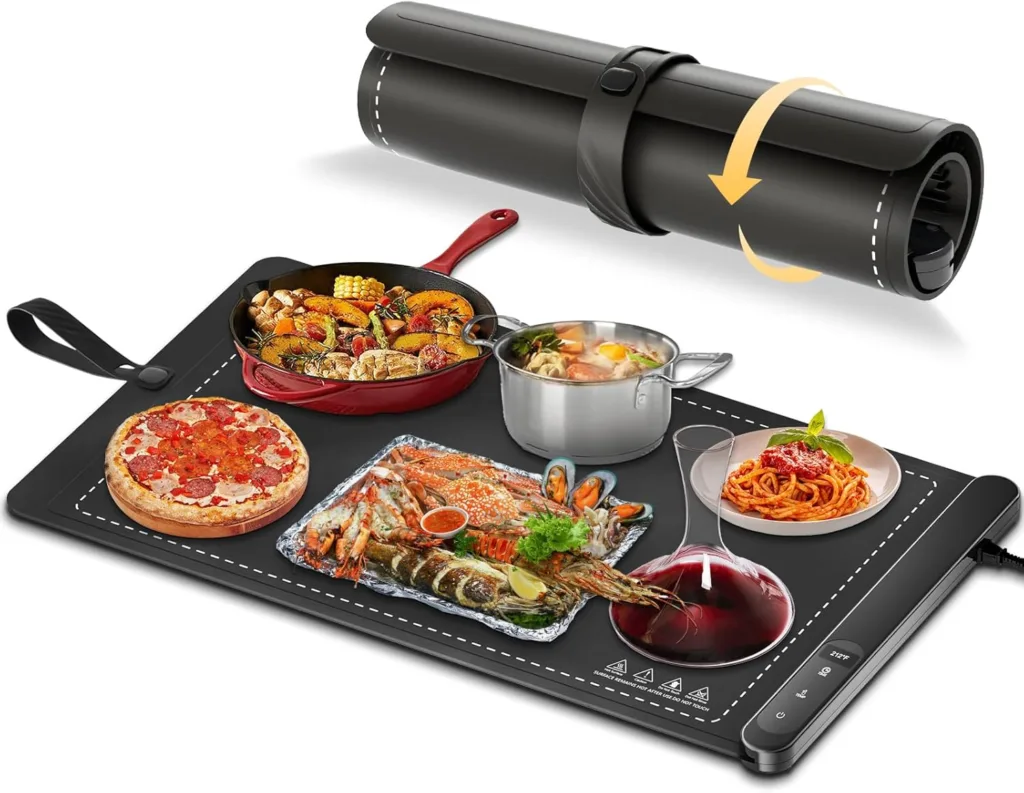
Graphene Food Warming Mat by HERTIENDO
Notably, the single-item price ($29.99) shows no visible discount. The strongest saving appears only in the two-item bundle, where a 42 percent reduction is revealed after interaction. This layered pricing strategy rewards exploration but risks being missed by hurried shoppers.
The product card feels calm and trustworthy, supported by Amazon’s Choice, solid ratings, and recent purchase volume. However, the lack of immediate savings reduces the “deal” signal.
UX-wise, this offer works best for users already solving a concrete holiday problem. Amazon relies on situational relevance rather than urgency, which is effective — but less forgiving for casual bargain hunters.
Product Snapshot 3: VIVOHOME 6FT Christmas Inflatable Snowman Family
This product – VIVOHOME 6FT Christmas Inflatable Snowman Family – is a pure seasonal purchase, designed for visibility and festive impact rather than utility. The 21 percent discount (from $69.99 to $54.99) is immediately clear and aligns well with Christmas expectations for decorative items.

VIVOHOME 6FT Christmas Inflatable Snowman Family
Strong social proof — Amazon’s Choice, 2,000+ reviews, and recent sales — combines with visual storytelling to speed up decision-making. Users can quickly imagine the product in their own space, reducing uncertainty.
The main UX friction appears at the variant level. Multiple snowman designs with different prices and discount depths fragment the value message, requiring brief comparison before committing.
Overall, Amazon handles this deal well: savings feel real, setup anxiety is addressed, and the experience supports fast, emotionally driven decisions — exactly what shoppers expect from Xmas decor deals.
Product Snapshot 4: Aromatherapy Shower Steamers 8-Pack by HFHO
This is one of the strongest examples of an effective Amazon Xmas deal: Aromatherapy Shower Steamers 8-Pack by HFHO. The 44 percent Prime-exclusive discount drops the price from $15.99 to $8.99, making the value immediately obvious.

Aromatherapy Shower Steamers 8-Pack by HFHO
The product card reinforces confidence through scale: 40K+ purchases in the past month, solid ratings, per-unit pricing clarity, and a visible sustainability feature. For stocking stuffers, this reduces both financial and emotional risk.
The benefit is easy to understand — relaxation, variety, and self-care — with no need for deep product knowledge. Style variations exist but do not undermine the highlighted deal’s value.
From a UX standpoint, this is where Amazon excels most: deep discounts, low decision cost, strong social proof, and clear Prime value combine to create fast, confident purchases with minimal friction.

Aromatherapy Shower Steamers 8-Pack by HFHO
The Role of Amazon Prime During Xmas Deals
During the Christmas period, Amazon Prime shifts from being a background subscription to a central UX mechanism. In 2025, Prime is no longer framed simply as “free shipping.” It becomes an assurance layer that touches almost every anxiety a holiday shopper has: timing, availability, and decision confidence.
The most tangible value Prime delivers during Xmas deals is delivery certainty. Prime members see clearer, earlier, and more reliable delivery promises, often with explicit “arrives before Christmas” messaging. From a UX perspective, this is critical. Under seasonal pressure, delivery speed is not a perk — it is part of the product. Prime reduces perceived risk by collapsing the gap between purchase and reassurance.
Exclusive Prime discounts further reinforce this value. Many Xmas deals are either labelled as Prime-only or framed with stronger savings for members. This creates a sense of access rather than exclusion. Users do not feel they are paying more; they feel they are unlocking something. In behavioural terms, Prime reframes price sensitivity into membership justification, especially when discounts are clearly visible and time-bound.
Convenience is where Prime quietly does most of its work. Faster checkout, default shipping preferences, simplified returns, and consistent service expectations reduce friction across the entire journey. For frequent Amazon users, this convenience becomes invisible — but during the holidays, its absence is immediately noticeable. Prime smooths complexity at a time when cognitive load is already high.
At the emotional level, Prime also creates the feeling of being a “privileged shopper.” Prime badges, delivery prioritisation, and exclusive pricing reinforce identity: the user is not just shopping, but shopping smart. This sense of status is subtle, but it significantly influences trust and speed of decision-making during Xmas deals.
However, Prime does not always enhance the experience. When discounts are framed in a way that obscures non-Prime pricing, or when the best offers appear locked behind membership, Prime can feel less like a benefit and more like a soft gate. For non-members, this introduces friction and frustration, especially if value comparisons are not immediately transparent.
So, is Prime worth it purely for amazon xmas deals? For occasional shoppers, the answer depends on urgency and volume. If delivery reliability and reduced decision stress matter more than marginal price differences, Prime delivers real value. For frequent users, Prime functions less as a holiday tool and more as an infrastructure — one that becomes most visible, and most valuable, when the stakes of getting things wrong are highest.
Are Amazon Xmas Deals Actually Good Value in 2025?
Looking across the four examples, a clear UX pattern emerges. Amazon Xmas deals in 2025 are not primarily designed to deliver the deepest possible discounts. Instead, they optimise for confidence, speed, and decision comfort. Savings are present, but they are uneven — ranging from modest reductions to genuinely strong value — and they are rarely the sole driver of conversion.
From a financial perspective, some deals are objectively better than others. Low-cost, high-volume items with visible percentage discounts deliver the clearest value signals. Higher-priced or more functional products often rely on timing and relevance rather than headline savings. What Amazon consistently avoids is ambiguity around availability or delivery, even if price competitiveness varies by category.
When weighing financial benefit against convenience and speed, Amazon’s advantage becomes more pronounced. The platform reduces friction at every step: discovery, evaluation, checkout, and post-purchase reassurance. For holiday shoppers, this matters more than small price differences elsewhere. The real value lies in reducing the cost of mistakes — late deliveries, unreliable sellers, or unclear returns — rather than maximising savings in isolation.
In terms of expectations, Amazon largely delivers on what users come for during Christmas. Shoppers expect clear deals, fast delivery, and low cognitive effort, and this is where Amazon performs strongly. Where expectations can break down is in transparency. Not all deals are equally good, and some require closer inspection than their presentation suggests. Experienced users learn to read Amazon’s signals carefully rather than taking “Xmas deal” labels at face value.
Compared to competitors, Amazon’s edge is not pricing alone but experience orchestration. Few platforms combine scale, logistics, trust, and interface familiarity as effectively during peak season. Competitors may occasionally undercut prices, but they often struggle to match Amazon’s reliability under pressure.
In 2025, Amazon Xmas deals offer solid — though not universally exceptional — value. Their strength lies in making “good enough” choices feel safe, fast, and emotionally reassuring. For many shoppers, that balance is worth more than chasing the absolute lowest price elsewhere.
UX Takeaways for Shoppers and Brands
For shoppers, the key takeaway is simple: Amazon Xmas deals are optimised for reassurance, not optimisation. The platform helps you make fast, low-risk decisions under pressure, but it does not always surface the best deal automatically. Looking beyond headline labels — checking delivery dates, variant pricing, and reference prices — often reveals where the real value sits. In the holiday context, confidence and timing are usually worth more than marginal savings.
Reading Amazon’s offers more consciously means understanding its signals. Badges like “Amazon’s Choice,” recent purchase volume, and Prime exclusivity are not neutral indicators — they are UX shortcuts designed to accelerate decisions. Used wisely, they save time. Used blindly, they can obscure better alternatives within the same category. Awareness turns these cues from persuasion into tools.
Several Amazon UX decisions stand out as particularly effective during Xmas deals. Delivery clarity reduces anxiety at the most critical moment. Free returns lower emotional risk, especially for gifts. Consistent layout and familiar interaction patterns minimise cognitive load when users are already overwhelmed. These elements work together to make buying feel safe, even when discounts are modest.
For brands, Amazon’s holiday approach offers clear lessons. Visibility matters as much as price. Products that communicate purpose, social proof, and seasonal relevance outperform those that rely on discounts alone. Simplicity is critical: clear pricing, limited variants, and obvious use cases reduce friction during peak demand.
Most importantly, Amazon demonstrates that value is not only financial. During Christmas, UX is about protecting users from regret. Brands that design for clarity, reassurance, and effort reduction — rather than pure price competition — are far more likely to win attention and trust when it matters most.


