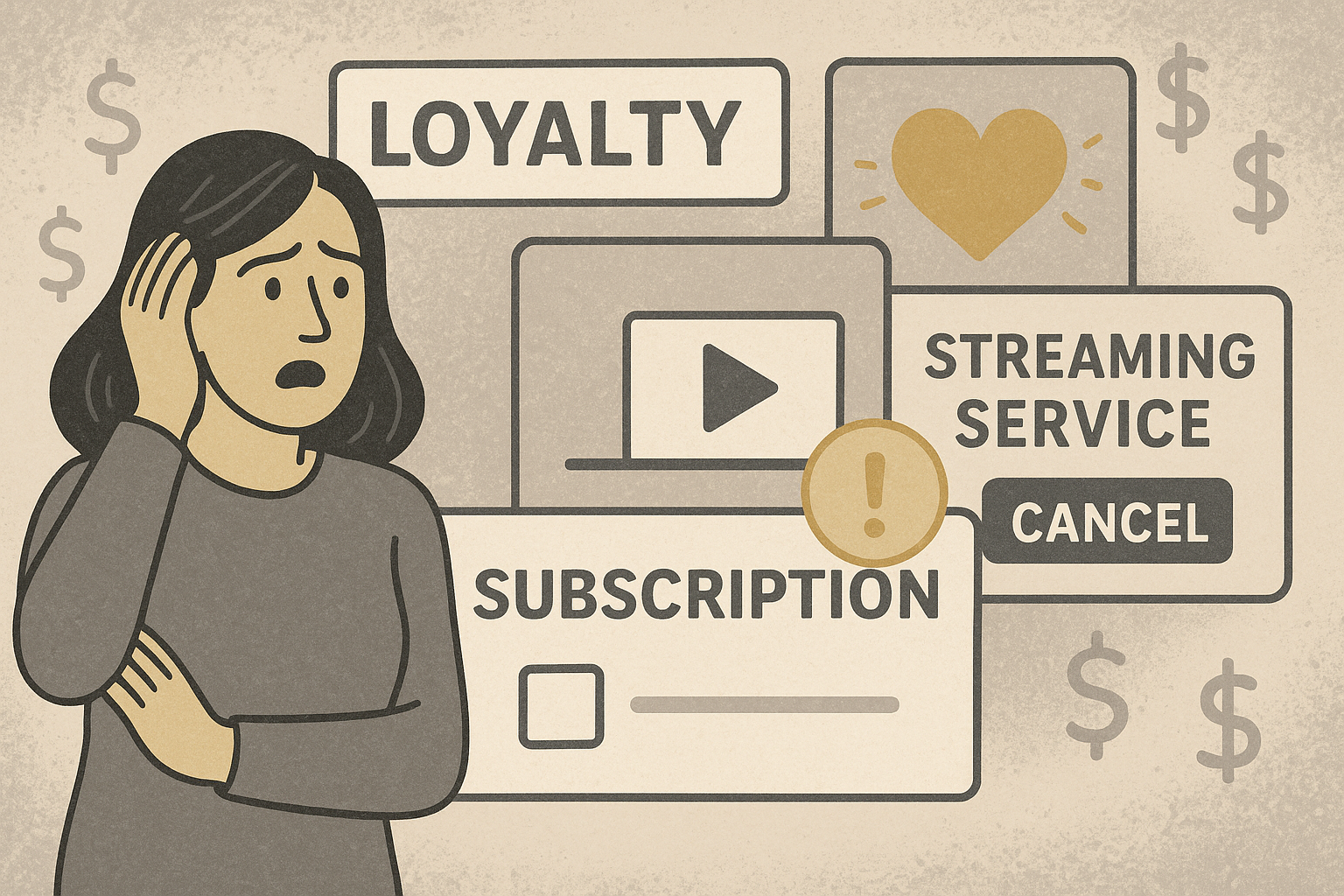
When churn hides in plain sight: how flawed journey mapping misleads teams and masks the moments that truly drive attrition.
Subscription-based businesses live and die by retention. Whether you’re a telecom provider promising seamless connectivity or a streaming platform delivering endless content, the core economic model depends on predictable, recurring revenue. But in a competitive market saturated with choice, customers cancel faster than companies can react—and too often, product and loyalty teams don’t understand why.
At FinUXlab, we’ve spent the past year immersed in the intricacies of subscription loyalty—conducting user journey audits, friction mapping, and churn analysis across more than 30 programs. One pattern emerged repeatedly: churn doesn’t always occur where you expect it. And worse, flawed Customer Journey Maps (CJMs) often create a false sense of confidence, concealing the very experiences that push customers away.
Why Classic CJMs Miss the Mark
On the surface, most CJMs in subscription businesses appear comprehensive. They outline the standard lifecycle: acquisition, onboarding, usage, renewal or cancellation. Yet beneath this structured flow lies a critical weakness: they’re built on assumptions, not on observed behavior.
Many journey maps are reverse-engineered from internal KPIs. They anchor around what the company wants the customer to do—subscribe, upgrade, renew—not what the customer actually experiences. As a result, the moments that create emotional friction, confusion, or eroded trust are either glossed over or omitted entirely.
Case in Point: A Streaming Platform’s Onboarding Loop
In one audit, we mapped the onboarding process of a global streaming service that boasted high engagement and above-average trial-to-paid conversion rates. Yet the churn rate during the third billing cycle was alarmingly high.
What the internal CJM missed was the psychological shift from exploration to commitment. Through qualitative interviews, we uncovered that users began questioning the subscription’s value once they realized the recommendation engine wasn’t adapting to their tastes. The first two months felt exploratory—by month three, the novelty wore off, and lack of personalization became a deal-breaker. None of this was visible in metrics. The churn trigger wasn’t usage-based—it was emotional dissonance.
Where Churn Really Happens: The Overlooked Touchpoints
Across telecom, streaming, and SaaS subscriptions, we’ve identified several UX blind spots that consistently generate churn. These aren’t always tied to big moments like sign-up or cancellation. They’re often micro-interactions, scattered across the lifecycle, that quietly accumulate user frustration.
- The Cancellation Catch-22
Making cancellation deliberately difficult might buy time, but it also poisons trust. When users are forced to hunt through menus, call support, or navigate dark patterns, they may stay for another month—but they’ll never come back. Worse, they’ll tell others not to start. - Billing Surprises
Unexpected fees, poorly explained price hikes, or vague descriptions of “premium access” erode perceived fairness. Even loyal users disengage when the value proposition feels like a moving target. - Rewarding the Wrong Behaviors
Many loyalty programs in subscriptions reward longevity alone. But today’s users expect more—relevance, recognition, and reciprocity. A user who streams 50 hours a month but never sees a tailored offer may feel invisible compared to a less engaged user who was simply there longer. - Neglecting the Plateau Phase
Most programs over-optimize for onboarding and retention at crisis points (e.g., failed payment retries). But the plateau—the long stretch of routine use—is when emotional loyalty is either cultivated or lost. If you’re not actively adding delight or utility during this phase, churn becomes inevitable.
How UX Research Reveals the Truth Behind Retention
The solution isn’t to scrap CJMs—but to rebuild them based on evidence, not assumption. At FinUXlab, our approach to loyalty research in subscription models includes:
- Contextual Inquiry & Diary Studies
We observe how users behave in their real contexts—not just in usability labs. This helps surface the small frustrations that lead to long-term dissatisfaction. - Churn Interviews with Leavers
We don’t just talk to retained users. We reach out to those who left. Their feedback is often richer and more honest, revealing the silent churn pathways product teams miss. - Friction Mapping
We create a layer beneath the standard CJM that identifies cognitive, emotional, and operational friction—especially in areas like billing, plan management, and reward redemption. - Behavioral Archetypes, Not Personas
Loyalty isn’t just demographic—it’s behavioral. We segment users by how they interact with value: the optimizers, the explorers, the oblivious. This leads to more precise interventions.
Example: Telecom Loyalty Done Right (and Wrong)
In one telecom case, our research uncovered that a significant segment of customers never engaged with the loyalty app—not because they lacked interest, but because they assumed it was only for prepaid plans due to outdated onboarding content. Once this misconception was removed and messaging was updated, activation rates for postpaid users doubled.
In contrast, another provider lost thousands of high-value subscribers due to a misleading offer that promised “unlimited roaming” without clarifying the fair use policy. The resulting backlash was visible only in cancellation notes—not in analytics dashboards.
Toward Smarter Loyalty in Subscription Models
Subscription churn isn’t a puzzle to be solved with more dashboards. It’s a human problem—often rooted in mismatched expectations, neglected experience moments, and poorly articulated value.
To move forward, loyalty programs need:
- Evidence-driven journey maps
- A deep understanding of emotional friction
- Ongoing UX monitoring, not one-off audits
- Flexible reward logic that adapts to usage behaviors
- Transparency in pricing and policies
Final Thought: Retention Is a UX Problem First
When users leave a subscription, it’s not just a business loss—it’s a breakdown in the relationship. No amount of win-back emails can fix a trust issue born months earlier from a confusing interface or an unkept promise.
At FinUXlab, we help subscription brands stop guessing and start understanding. Because behind every canceled plan is a story—and it’s our job to listen before it becomes a pattern.